Maximizing Your Trademark Success with ipReNewAl’s Direct Filing Services
Trademark protection is essential for businesses looking to safeguard their brand identity. Choosing the right filing approach can significantly impact the success of trademark registration and cost-effectiveness. At ipReNewAl, we offer a superior trademark filing service, providing expert guidance and direct filing options at a more affordable rate than the Madrid Protocol. Here’s why this approach benefits businesses like yours:
Why Direct Filing Trumps the Madrid Protocol
Many companies opt for the Madrid Protocol, assuming it simplifies the process by allowing a single application for multiple jurisdictions. However, data from the USPTO’s trademark dashboard shows a lower acceptance rate for Madrid Protocol filings compared to direct filings. The graphic below illustrates the comparative success rates of these filing methods:
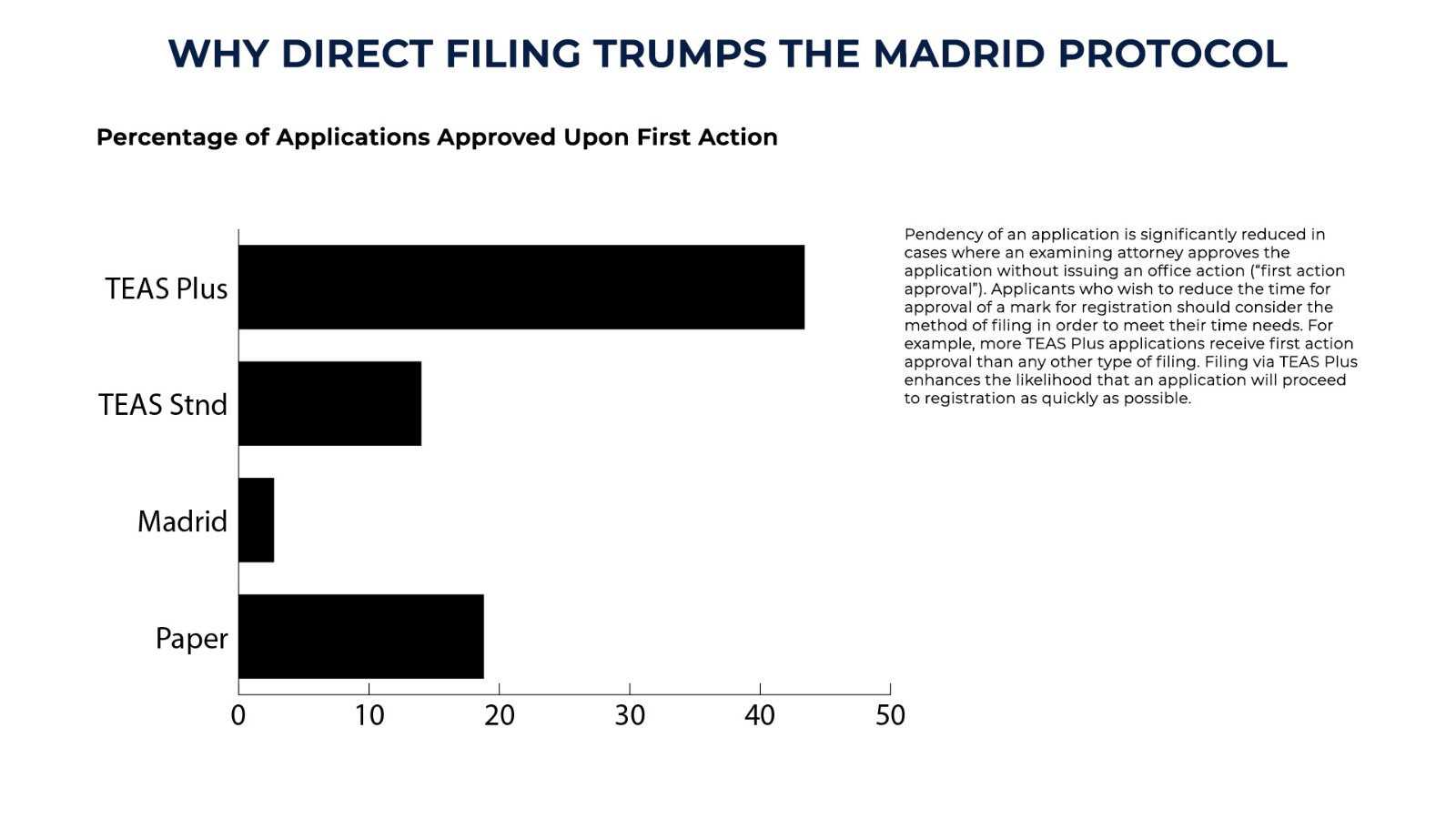 Source: https://www.uspto.gov/dashboard/trademarks/
This lower acceptance rate is primarily due to differences in the way authorities handle trademark classifications, goods, and services.
Jurisdiction-Specific Challenges
Goods and services listed and accepted by one authority may not be accepted by another. This discrepancy often leads to amendments, additional fees, and delays in approval, particularly under the Madrid Protocol, where one amendment can affect all jurisdictions involved.
At ipReNewAl, we understand these challenges and offer a direct filing service that mitigates these risks. Our expert team collaborates with global trademark professionals to ensure that your trademark application complies with the specific requirements of each jurisdiction, significantly improving your chances of approval and avoiding costly amendments and delays.

Affordable Pricing, Higher Success Rates
While the Madrid Protocol is commonly perceived as a cost-saving option, its lower acceptance rate and the potential need for amendments can quickly increase overall costs. ipReNewAl offers direct filing services at a price point that’s even lower than what you would typically spend through the Madrid Protocol. Additionally, our all-in-one package includes handling any jurisdiction-specific requirements upfront, saving you both time and money in the long run.

We Handle Amendments, So You Don’t Have To
One of the biggest frustrations in the trademark registration process is dealing with amendments that arise due to conflicting goods or services classifications. At ipReNewAl, we take care of these issues on your behalf, ensuring a smooth process. Should any adjustments be necessary, we handle the back-and-forth communication with local authorities, absorbing the complexity and minimizing additional fees.

Conclusion
Choosing ipReNewAl for your trademark filing needs ensures a higher likelihood of success and cost savings, compared to filing through the Madrid Protocol. Our direct filing service is not only more affordable but also tailored to meet the requirements of each jurisdiction. We handle the complexities, so you don’t have to, letting you focus on building and growing your brand.

Why Direct Filing Often Outperforms the Madrid Protocol
The Madrid Protocol is widely promoted as the go-to solution for international trademark registration — but it comes with significant trade-offs that many businesses discover only after a costly application failure. The Madrid Protocol routes your application through WIPO, which then submits it to each designated country’s trademark office. If an examiner in any of those countries raises an objection, your entire multi-country application can be affected, and resolving individual country refusals often requires engaging local attorneys anyway.
Direct filing — submitting separate applications in each jurisdiction through local agents — gives you more control over each application, the ability to tailor the specification of goods and services to each country’s requirements, and a cleaner path to resolution if objections arise. For businesses with a defined target market of two to five countries, direct filing frequently delivers a faster grant and higher overall success rate.
What ipReNewAl’s Direct Filing Service Covers
ipReNewAl’s direct filing service manages the complete trademark filing process from initial consultation through to grant. This includes conducting pre-filing availability searches in your target jurisdictions, preparing and filing the applications with local trademark offices, monitoring examination status, responding to office actions, and notifying you of any third-party oppositions during the publication period.
The service is designed for businesses that want professional management of their international trademark portfolio without the complexity of coordinating multiple local law firms across different countries and time zones. ipReNewAl handles the coordination, keeping you informed at each milestone with clear, jargon-free updates.
Choosing the Right Goods and Services Classification
Trademark applications are filed under one or more classes in the Nice Classification system, which divides goods and services into 45 classes. Choosing the right class or classes is critical — an application filed in the wrong class will not protect your brand in the areas that matter most to your business, and an overly broad classification strategy increases both cost and the risk of conflicts with existing registrations.
A common mistake is to file in too many classes “just to be safe” without considering whether genuine use can be demonstrated in each. In many jurisdictions, trademark registrations can be challenged if the mark is not used for all the goods and services listed within a certain period. Getting the classification right from the start — specific enough to cover your actual and intended business activities — is one of the most important services a professional filing agent provides.
Trademark Monitoring After Grant: An Overlooked Priority
Obtaining a trademark registration is an achievement, but it is not the end of the process. Once your mark is registered, you bear the responsibility of monitoring the trademark register for potentially conflicting applications filed by third parties. If a third party files an application for a mark that is confusingly similar to yours in a related area of trade, you have a limited window to file an opposition.
Without active monitoring, you may miss this window entirely — and once a conflicting mark is registered, cancellation is significantly harder and more expensive than opposition. ipReNewAl’s trademark management service includes ongoing monitoring alerts to ensure you are always aware of potential conflicts before they become problems.
Frequently Asked Questions About Trademark Direct Filing
How is direct filing different from the Madrid Protocol?
Direct filing involves submitting separate applications in each target country through local agents or a coordinating service. The Madrid Protocol uses a single WIPO application to cover multiple countries. Direct filing generally provides more flexibility and higher success rates in specific jurisdictions.
How long does trademark registration take with direct filing?
Timelines vary by country — typically 6 to 18 months for straightforward applications. Some jurisdictions like the USA can take longer if office actions or oppositions arise.
What happens if my trademark application is rejected?
If an examiner raises objections, you will have an opportunity to respond and address the issues raised. Your filing agent can advise on the best response strategy. In many cases, objections can be overcome with a well-prepared response.
Can I file in any country through ipReNewAl’s direct filing service?
ipReNewAl works across a wide range of jurisdictions. Contact the team to discuss your specific target markets and get a tailored quote for your trademark filing requirements.
Country-Specific Trademark Filing Guides
Trademark registration requirements, timelines, and fees vary significantly between jurisdictions. ipReNewAl provides direct filing services across all major markets. Explore our country-specific guides for detailed information on local trademark authorities, examination procedures, and renewal processes:
- Trademark Registration in the United Kingdom (UKIPO) — post-Brexit requirements, UK Trade Mark registration, renewal every 10 years
- Trademark Registration in Europe (EUIPO) — EU Trade Mark (EUTM), single application covering all 27 EU member states
- Trademark Registration in Singapore (IPOS) — Singapore’s efficient IP system, ASEAN market gateway, 10-year renewal
- Trademark Registration in the UAE — Ministry of Economy registration, GCC market access, Arabic-language requirements
- Trademark Registration in Austria — Österreichisches Patentamt, Austrian and EU filing options
- Trademark Registration in Switzerland (IPI) — non-EU, independent examination, CHF-denominated fees
- Trademark Registration in New Zealand (IPONZ) — trans-Tasman framework, alignment with Australian IP law
- Trademark Registration in Malaysia (MyIPO) — ASEAN market, 10-year term, multi-class filing
- Trademark Registration in Taiwan (TIPO) — Taiwan Intellectual Property Office, 10-year renewable term
- Trademark Registration in Israel — Israel Patent Office, Nice Classification, 10-year renewable term
New to Trademark Registration? Start Here
Before you can file and protect your trademark internationally, you need to complete the initial registration in your home country. Our comprehensive step-by-step guide covers the entire trademark registration process — from choosing a registrable mark and conducting clearance searches to filing your application, responding to examination, and maintaining your registration long-term.